
Gallery
Roads and Rivers – Building the Logic Behind a Believable Overworld
A look at the development of the road and river logic for Veildelve's overworld – from clean connections between hex tiles to consistent widths across curves, branches and transitions.
The overworld of Veildelve – A World Shaped by Aether is not meant to feel like a collection of isolated hex tiles. It should gradually form a connected and believable landscape. One important part of that is the underlying logic used for roads and rivers.
Recent development work has therefore focused on making both systems connect reliably across multiple hexes while maintaining a consistent visual appearance.
Roads need more than a line from edge to edge
Drawing a road from one edge of a hex to another is relatively simple. The challenge begins once curves, branches and different road configurations have to connect with each other.
Without additional logic, these situations can quickly create visible gaps, overlaps or unnatural transitions.
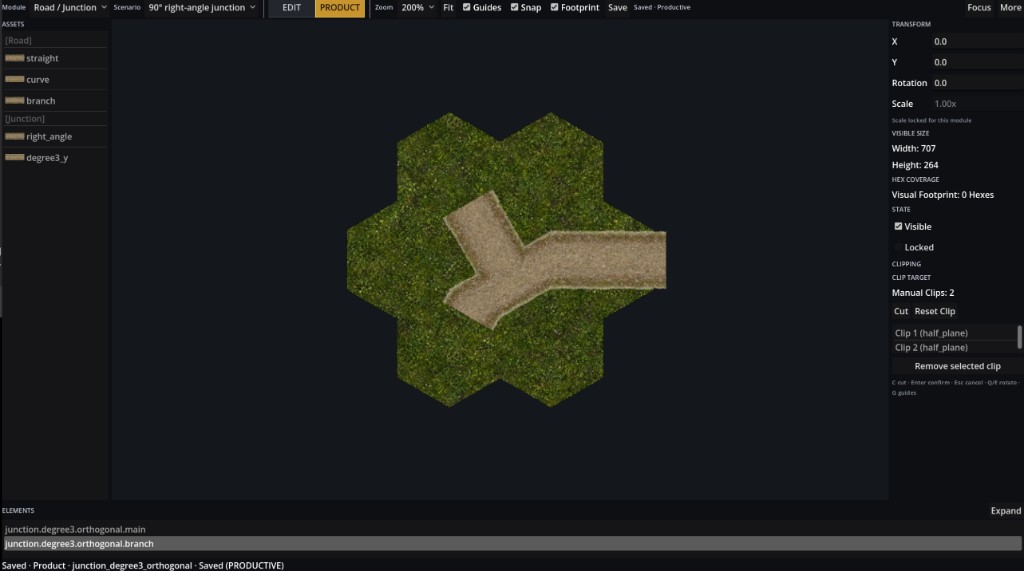
A significant part of the recent work therefore focused on road junctions and branching paths. Y-shaped junctions in particular required additional refinement so that the branching road connects convincingly into the main road.
The goal is a system in which different road elements can eventually be combined freely — straights, curves, branches and Y-junctions — without requiring manual fixes for every individual map configuration.
Rivers are sensitive to small differences
Rivers introduced a different set of challenges. Even relatively small differences in geometry can make a curved river appear much wider than a straight section.
The river system has therefore been adjusted so that straight sections, curves, crossings and branches share the same visual width.
Bridge crossings are part of this work as well. A river should maintain its natural width underneath a bridge instead of suddenly expanding or narrowing.
The same principle applies to Y-shaped river junctions. Main rivers and side branches need to merge naturally without creating an oversized body of water in the centre or leaving visible internal shoreline fragments where the two sections meet.
Hex-edge connections matter
Another important part of the system is the connection point along the edges of each hex. Roads and rivers need to reach these points consistently enough that neighbouring tiles can connect without visible offsets.
Individually, many of these details may seem minor. Across a large overworld made from many interconnected tiles, however, they strongly influence whether the landscape feels continuous or visibly assembled from separate pieces.
More than decoration
Roads and rivers are therefore more than visual decoration. They are structural parts of the world and need reliable underlying rules.
The current work establishes the foundation for assembling increasingly varied road and river layouts from reusable hex elements while keeping their appearance consistent.
Road Y-junction
At Y-junctions, the branching path needs to connect convincingly into the main road — without visible gaps or unnatural transitions at the centre.
Current development statusRoad curve
Curves must keep the same road width and meet hex edges precisely, so neighbouring tiles can connect without visible offsets.
Current development statusRiver curve
River curves tend to appear wider than straight sections. The rendering has been adjusted so curves and straights share the same visual width.
Current development statusRiver Y-junction
Main flow and side branch need to merge naturally — without an oversized body of water or visible internal shoreline fragments at the centre.
Current development statusNote on the images:
The captures shown come from the working tool used during ongoing development of Veildelve. Presentation, placement, and individual elements may still change as development continues.