
Gallery
The overworld takes shape: biomes, terrain, and pathfinding
An early look at the in-game development of Veildelve's overworld – featuring biomes, terrain, landmarks, and first approaches to pathfinding.
I am currently building the overworld of Veildelve - A World Shaped by Aether. The images in this post are early in-game captures from the current development state.
Right now, the focus is on finding out how different biomes feel, what scale works best for terrain objects, and how the world can remain readable while supporting meaningful travel.
Different biomes need more than a different ground texture
A green region should not differ from dry or rocky areas through ground texture alone. Vegetation, rocks, ruins, landforms, and distinctive objects should work together to give each region its own character.
I am currently testing how densely such elements can be placed and which details remain clearly visible from the actual in-game perspective.
This is especially important on an overworld map: an object can look very detailed on its own and still feel too small or too inconspicuous in the game.
Terrain is not just decoration
Rocks, mountains, ruins, and other landmarks should not simply be scattered randomly across the map. They should help with orientation and later also gain gameplay significance.
A larger mountain range, for example, can block a direct route between two regions. A striking ruin or an old monument, on the other hand, can already visually point toward an interesting location.
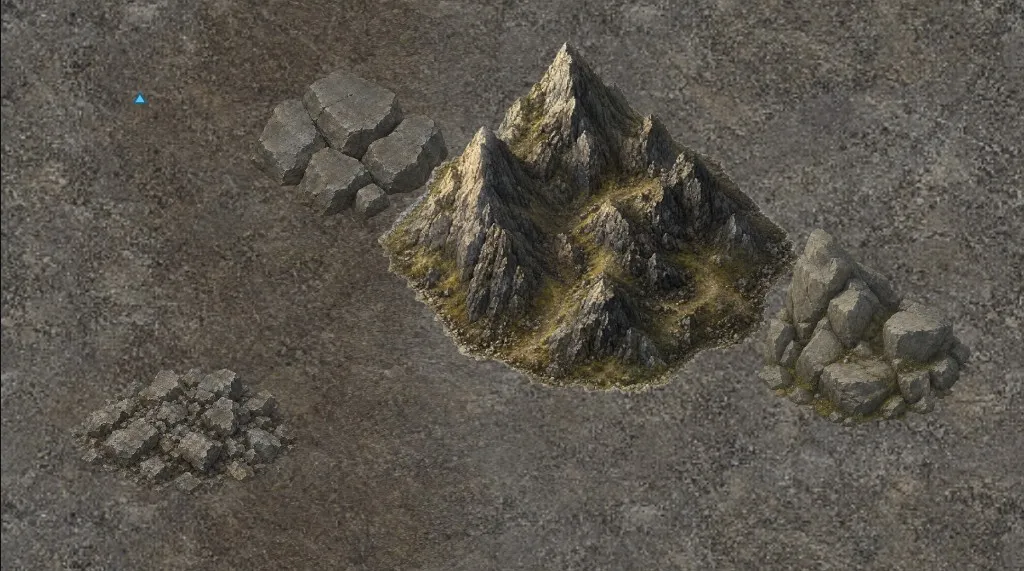
The large mountain formation in one of the screenshots is partly a test of how clearly such landscape elements need to stand out from their surroundings so that they are actually perceived as part of the world.
Pathfinding and regions belong together
Alongside the visual design, the foundation for movement across the overworld is taking shape.
You should not simply be able to select any point and travel there directly. Regions are connected to one another, and these connections determine the possible routes through the world.
This means route choice can become interesting later on. A direct path might be blocked by terrain, while a detour leads through another region. Other routes might be shorter but pass through more dangerous areas.
What matters to me is that the overworld does not become merely a location-selection screen, but a meaningful part of the game itself.
What is not yet final in the images
The screenshots show an early stage of implementation.
The placement and density of terrain objects, transitions between biomes, paths, and landmarks will still be adjusted as development continues. Some of the elements currently visible are deliberately used as test objects and may be changed or replaced later.
Above all, this phase helps me identify what works in the actual in-game view and what still needs adjustment.
What comes next
Next, these individual tests will gradually develop into complete regions. Biomes, landforms, paths, and landmarks will be combined more closely, so that the separate building blocks gradually form a coherent overworld.
This step is especially interesting to me: from technical foundations and individual assets, a world you can actually explore is slowly beginning to emerge.
Dry biome
A barren overworld region with ruins, rocks, and sparse vegetation – an early test of how dry areas should differ from green or rocky regions.
Current development statusGreen biome
A green biome with an Aether monument, dense vegetation, and colourful plants – a test of how distinctive landmarks and vegetation shape the character of a region.
Current development statusRocky biome
A rocky overworld region with a large mountain formation and jagged rocks – a test of how clearly landscape elements need to stand out from their surroundings.
Current development statusNote on the images:
The screenshots shown are early in-game captures from the ongoing development of Veildelve. Presentation and content may still change as development continues.